
What is Cycle of Avoidance?
DBT is a type of cognitive-behavioral therapy originally developed in the 1980s by Marsha Linehan, a psychologist at the University of Washington. Although initially intended to help chronically suicidal individuals diagnosed with borderline personality disorder, DBT has since been adapted for and used to effectively treat a number of other psychological problems. The skills you learn in DBT consist of four areas: mindfulness, distress tolerance, interpersonal effectiveness, and emotional regulation.
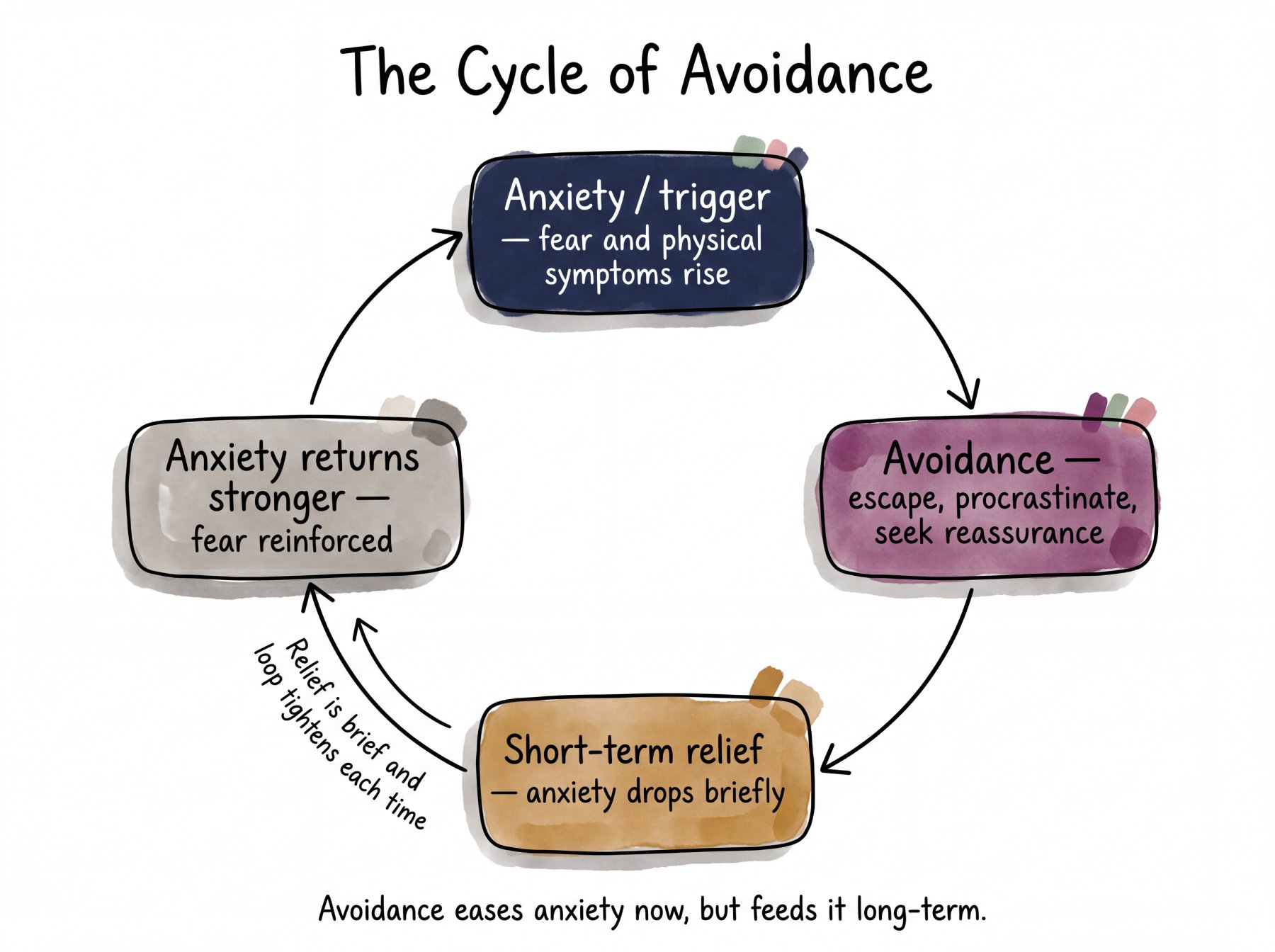
Cycle of Avoidance presents the four stages of the anxiety cycle: the trigger that sets off anxiety, the avoidance behavior the client uses to escape it, the temporary relief that follows, and the paradoxical result—stronger anxiety the next time. The sheet includes concrete examples (social situations, procrastination, learning new skills) that show how the cycle plays out in daily life and why facing fears gradually, rather than avoiding them, builds confidence.
How therapists use it
Introduce this sheet when a client is stuck in avoidance patterns and needs to understand why their anxiety persists despite their efforts to manage it. Psychoeducation interventions usually consist of information about the development and maintenance of a particular mental disorder, the principles behind the treatment of that disorder, and suggestions for coping strategies. Walk through the four stages together, then ask the client to identify their own cycle—what triggers their anxiety, what they do to avoid it, and what happens next. This builds the foundation for moving toward exposure-based work, where the client learns that facing anxiety gradually, in small steps, breaks the cycle.
Who it's for
This sheet works well for clients with anxiety who are new to understanding how their own avoidance maintains their symptoms. Exposure therapy centers on the idea that confrontation of fear breaks the cycle of avoidance, and exposure to fear-producing stimuli in a safe environment can help mitigate avoidance behavior. Clients who are ready to move from avoidance toward gradual exposure benefit most from this psychoeducation first. It is less useful for clients who already understand the avoidance cycle or who are not yet ready to consider facing their fears. DBT can be an effective treatment for mental health conditions such as anxiety, PTSD, substance use disorder, bipolar disorder, and depression.
What clients see
The client reads a clear explanation of the four-stage anxiety cycle, with physical sensations and thoughts described at each stage. Three real-world examples show how the cycle works in different situations. The sheet ends with a brief note that facing fears gradually, one small step at a time, is how confidence grows.
Page 1
The Four Stages of Anxiety Anxiety often works in a cycle, and understanding that cycle can help you take back control. There are four main stages: Stage 1: Feeling Anxious Something sets off your anxiety—maybe a situation or even just a th…
Modality fit
DBT uses psychoeducation to help clients understand the mechanisms that maintain their symptoms, so they can engage more fully with skills training and behavioral change. Understanding the anxiety cycle—how avoidance reinforces fear—is foundational to DBT's distress tolerance and emotion regulation work, which teach clients to tolerate discomfort without escaping it.
Sources
- Mowrer, O. H. (1956). Two-factor learning theory reconsidered, with special reference to secondary reinforcement and the concept of habit.. Psychological Review
- Pitt de Splinter, M. (2014). Avoidance, Vicious Cycles, and Experiential Disconfirmation of Script: Two New Theoretical Concepts and One Mechanism of Change in the Psychotherapy of Depression and Anxiety.. Transactional Analysis Journal
Common questions
When should I use this with a client?
Use it early in treatment when a client is stuck in avoidance and doesn't yet understand why their anxiety keeps coming back. It prepares them for exposure-based work by showing them the mechanism they're caught in.
Does this sheet teach exposure therapy?
No. It explains why avoidance doesn't work and hints that facing fears gradually builds confidence, but it doesn't teach the steps of exposure. Use it as a foundation before moving to structured exposure work.
Can I use this with clients who have other anxiety disorders?
Yes. The anxiety cycle applies across specific phobias, social anxiety, panic disorder, generalized anxiety, and OCD. The mechanism—avoidance reinforced by temporary relief—is the same.
What if my client is not ready to face their fears?
This sheet may increase their awareness of the problem without offering a solution they feel ready for. Pair it with distress tolerance skills first, or use it as a conversation starter about readiness for change.